Cards That Accept USDT — How Charge-Type Crypto Cards Work and 7 Points to Check
A guide to cards you can top up with USDT and spend anywhere, and the 7 checkpoints worth verifying before you choose one — written from a card issuer's perspective.
By RAYS CARD Editorial
Last updated: July 16, 2026
"I hold USDT, but it never leaves the exchange." If that sounds familiar, this guide explains how cards that let you spend USDT actually work — and how to choose one.
In the interest of transparency: this article is written by us, the team behind RAYS CARD, a USDT/USDC charge-type card. Rather than steering you with a ranking, we've collected the checkpoints that matter no matter whose card you choose, from the vantage point of an issuer that knows how these products work on the inside.
"A card that accepts USDT" means two different things
When people search for this, they usually mean one of two things:
- Buying USDT with a card — purchasing USDT from an exchange with a credit card
- Spending USDT with a card — topping a card up with USDT you already hold and paying at stores or online
This article is about the second one — spending your USDT. If you're looking for the first, your exchange's official guide is the right place.
Cashback-type vs. charge-type — the two kinds of "crypto card"
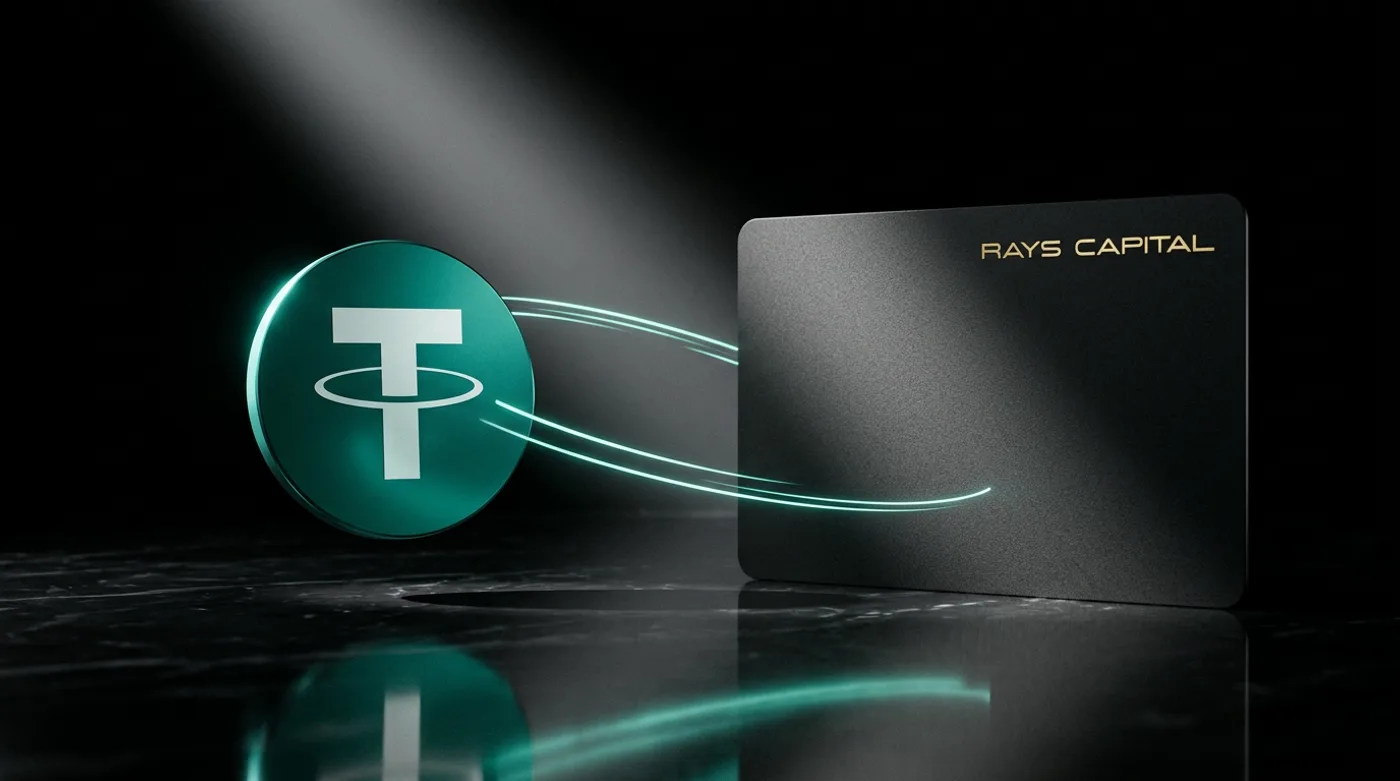
Cards marketed as "crypto cards" actually come in two mechanically different types.
| Cashback-type | Charge-type | |
|---|---|---|
| What pays for purchases | Fiat (a regular card payment) | The crypto you topped up |
| Crypto's role | You receive it as rewards | You spend it |
| Best for | Living on fiat while accumulating crypto | Spending the USDT/USDC you hold |
Many bank- and exchange-issued crypto cards are cashback-type. If you want a card that accepts USDT, what you need is a charge-type card. Mixing these up is how people end up with a card that can't actually spend their USDT.
How a charge-type card works
A charge-type card combines two things in one card:
- A crypto deposit endpoint — receives USDT/USDC over a blockchain
- A balance the card network can spend — a form Visa/Mastercard merchants can accept
When you top up, the crypto is converted into card balance, and from there it works like any other card. We cover the mechanics in more detail in How to spend USDT and USDC on everyday purchases.
7 checkpoints before you choose

1. Supported currencies — USDT only, or USDC too?
Some cards accept only USDT; others support USDC and more. Check that the card matches what you actually hold on your exchange or in your wallet.
2. Supported networks — fees and speed differ drastically
The same USDT costs and behaves very differently depending on the network you send it over (TRC20 / ERC20 / BEP20 and so on). A card that supports only one network may force extra swaps and transfers if it doesn't match your wallet. Multi-network support is a significant fork in the road.
Also: sending over a different network than the one you selected can mean losing your funds. Whichever card you use, double-checking before sending is non-negotiable (see notes on depositing crypto).
3. Fee structure — look at where fees apply before how much
Before comparing amounts, map out where fees occur:
- Issuance fee / annual fee
- On top-up (deposit)
- On payment
- On currency exchange (transactions in another currency)
- ATM and reissuance
A card that advertises "free issuance" may recover it through payment fees. Check every line on the official pricing page and the terms (for RAYS CARD, they're consolidated in About fees and the Terms of Service).
4. Virtual card, physical card, or both
If you only pay online, a virtual card is enough. For in-store payments and ATMs, check that a physical card is offered — and confirm the delivery regions and lead time.
5. KYC (identity verification) requirements
Charge-type cards move money, so identity verification is required. Conversely, a card that advertises "no KYC" is a signal to question — both for the risk of it abruptly ceasing to work and for the trustworthiness of the issuer itself.
6. Issuer transparency
Confirm the operating company's name, location, and support contact are published. When these are vague, there is nothing you can do if a balance ever fails to come back.
7. Statements and taxes
Depending on your jurisdiction, paying with crypto can itself realize a taxable gain or loss — which can mean keeping a record for every payment. Whether you can review and export your transaction history later makes a real difference at filing time.
Tax treatment varies by country and by personal circumstances. This article is not tax advice; please consult a qualified professional about your own filings.
How RAYS CARD measures up (issuer self-disclosure)
Applying the 7 checkpoints to our own card:
| Checkpoint | RAYS CARD |
|---|---|
| Currencies | USDT, USDC |
| Networks | BSC, ERC, TRC — 3 networks |
| Fees | Every line item published in the fees help and Terms |
| Card formats | Virtual + physical (delivery included in the issuance fee) |
| KYC | Required |
| Issuer | RAYS CAPITAL PTE. LTD. (Singapore) |
| Statements | Transaction history in the app, with CSV export |
Getting started
The typical charge-type flow is: purchase → activate → top up → spend. For RAYS CARD, each step has its own guide:
- Buy and pay for a card (payable with crypto or credit card)
- Activate your card
- Top up with USDT or USDC
- Then pay like you would with any card
FAQ
How is this different from cashing out?
Cashing out means selling on an exchange, withdrawing to a bank account, and then spending — multiple steps and often days of waiting. A charge-type card takes USDT as-is and turns it into spendable balance, skipping the cash-out procedure and the wait. (Either way, tax consequences may still arise depending on your jurisdiction.)
How fast do top-ups arrive?
As soon as the transfer is confirmed on the blockchain. Speed depends on network congestion. For RAYS CARD, see View your deposit history.
What happens to my balance if I lose the card?
A trustworthy card lets you freeze it instantly from the app. Whether you can stop the card yourself when it goes missing is an underrated checkpoint in its own right (for RAYS CARD: Suspend (lock) a card).
Summary
- If you want to spend USDT, you need a charge-type card, not a cashback-type
- Judge candidates on 7 points: currencies, networks, fee structure, card formats, KYC, issuer transparency, statements
- Network support and where fees apply shape the day-to-day experience more than anything else
For more about RAYS CARD, see the Help Center, or reach us via Contact.
RAYS CAPITAL PTE. LTD.
The editorial team at RAYS CAPITAL PTE. LTD., the company behind RAYS CARD. We write about cards, wallets, and crypto based on how the product actually works.
Related articles
How to Spend USDT and USDC on Everyday Purchases — How Crypto Cards Work
You can't pay at a store with USDT or USDC directly. Here is how a crypto card bridges that gap, and the exact steps to start spending with RAYS CARD.
2 min read